
Finding your Ikigai
Finding your Ikigai
Honeybrains Blog
Discovering Your Ikigai
A guide to finding purpose, meaning, and a healthier way to live.
By Dr. Jeanne Rosner, Founder of Soul Food Salon

Ikigai, pronounced "ic kee guy," is a Japanese word that means your reason for being. More simply, it is what motivates you to get up in the morning. Studies show that living with purpose and meaning may help people live longer and lower their risk of chronic disease, heart disease, and cancer. Research also suggests that having a strong sense of purpose supports long-term brain health.
Researchers at Rush University Medical Center found that higher levels of purpose in life reduced the harmful effects of plaques and tangles associated with Alzheimer's disease. A sense of purpose can help us live with more energy, gratitude, resilience, peace, satisfaction, and fulfillment. It also encourages other healthy lifestyle habits.
Ikigai originated on the island of Okinawa, Japan, home to one of the longest-lived populations in the world. Many Okinawans live by this deeply rooted way of thinking. During uncertain times, when stress and overwhelm can feel constant, ikigai can be a useful guide for finding focus and balance.
The four questions of ikigai
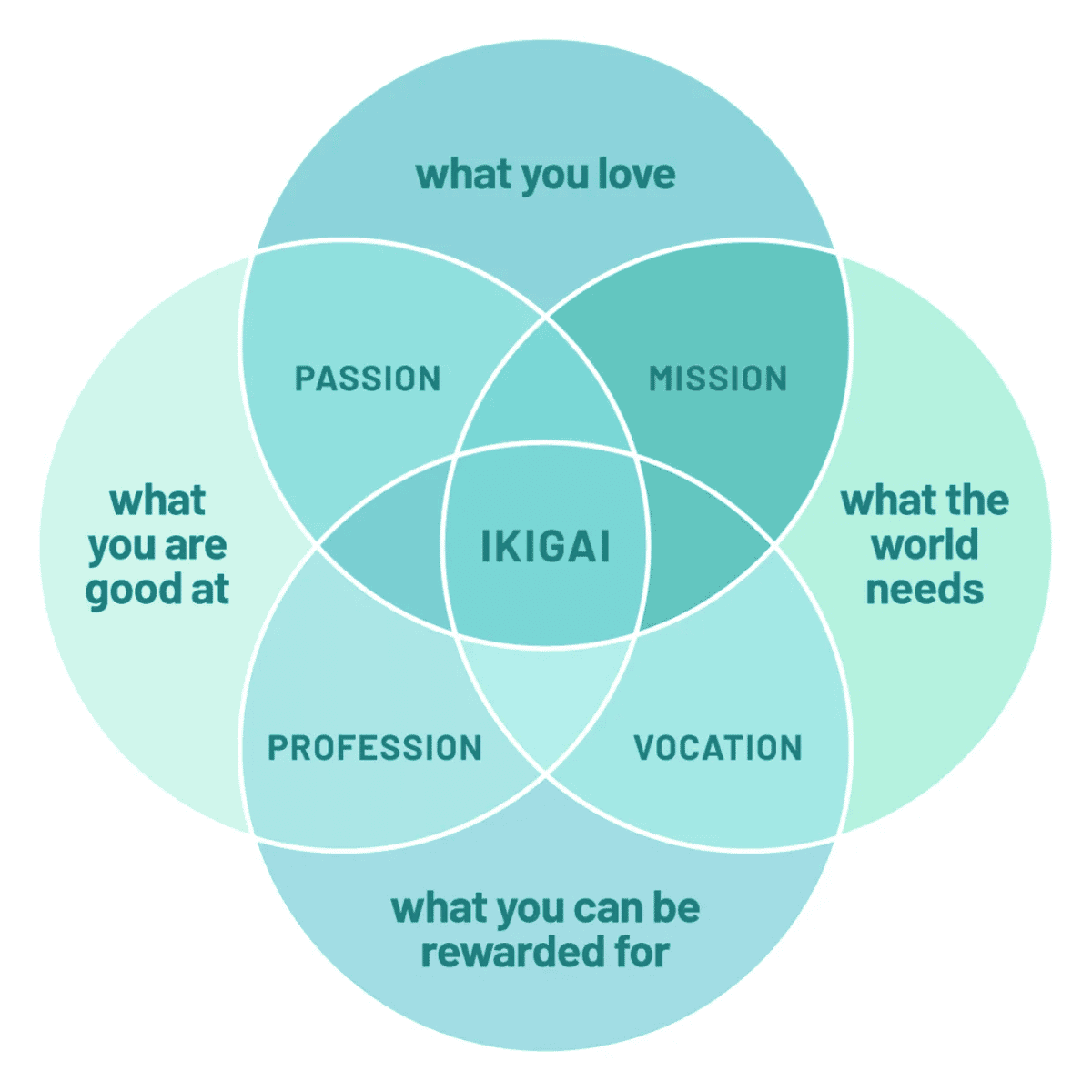
Ikigai is often explored through four core questions:
- What do I love?
- Where do my strengths lie?
- What does the world need?
- What services can I do and get rewarded for?
When these four areas overlap, that is where ikigai begins to take shape.
What do I love?
Ask yourself what brings you joy. What would your ideal day look like. What sparks your curiosity. What inspires you. These questions can help uncover your passion and point you toward what matters most.
One helpful exercise is creating a vision board. Use a poster board and fill it with words, images, and phrases from magazines or newspapers that speak to you. Seeing those themes together can reveal things that matter deeply to you, even if you had not fully realized them yet.
Dr. Rosner shares that when she created her own vision board, it highlighted themes like teaching, healthy eating, authenticity, and living her best life. At the time, she was working as a pediatric anesthesiologist. While she valued the work, it was also deeply stressful. Reflecting on her vision board helped her realize she wanted to teach health and wellness, which set her on the path she follows today.
Where do my strengths lie?
Think about your strongest talents. Are you more creative, analytical, or strategic. Do you prefer working with your hands or solving difficult problems. Do you enjoy working independently or with a group.
Dr. Rosner describes herself as a doer. She likes making progress toward a goal and does not fear failure. She values learning new things and sharing that knowledge with others. That mindset helped lead her to create SOUL Food Salon with the goal of educating and empowering people to live healthier lives.
What does the world need?
This question asks what social good you want to contribute. What kind of impact do you want to make. There are endless causes and communities that need support, both big and small, local and global. Spending time on an issue that matters to you can bring a deep sense of meaning and help build lasting relationships along the way.
Through SOUL Food Salon, Dr. Rosner has raised awareness for local nonprofits that share a mission of educating and empowering people to be healthier. Those partnerships have included The Edible Schoolyard Project, The Teaching Kitchen Course at Stanford Medical School, FoodCorps, and Fresh Approach.
What can I do and get rewarded for?
Reward can take different forms. It may be financial, and that is valid because our work helps support our lives and families. It may also come through community impact, nonprofit contributions, or the satisfaction of knowing others value your effort and service. The key is to think about what kind of reward feels meaningful to you.
Daily ways to cultivate ikigai
- Live in the present
- Find flow in everyday life
- Nurture meaningful relationships
- Live with less ego
- Be optimistic, smile, and laugh often
- Practice gratitude
- Exercise daily
- Build healthy nutrition habits
- Think less and keep an open mind
- Spend time in nature and slow down
A final thought
Psychiatrist David Viscott once said, "The purpose of life is to discover your gift. The work of life is to develop it. The meaning of life is to give your gift away."
Dr. Rosner's hope is that exploring ikigai can serve as a roadmap to a life that feels longer, healthier, and more meaningful.
About Jeanne Rosner
Jeanne Rosner, MD, is a board-certified anesthesiologist who practiced pediatric anesthesia at Stanford Medical Center for nearly 20 years. In 2011, she began teaching nutrition classes in her son's fifth-grade science class and discovered a new path in health, nutrition, and wellness education.
Since retiring from anesthesia, she has taught nutrition in middle and high schools throughout the Bay Area, helping students understand the value of eating closer to the source and making balanced food choices. She founded SOUL Food Salon in 2014 to educate and empower people to be healthier.
Website: www.soulfoodsalon.com
Email: jeanne@soulfoodsalon.com
Instagram: @soulfoodsalon
Resources
- My Little Ikigai Journal by Amanda Kudo
- Association Between Life Purpose and Mortality Among US Adults Older Than 50 Years, JAMA Network Open
- Kathy Weinkle, Career Coach