
The 10 Key Biomarkers of a Healthy Brain
The 10 Key Biomarkers of a Healthy Brain
Honeybrains Blog
The 10 Key Biomarkers for Brain Health
How your body health supports your brain health, and the routine tests that can help you better understand both.
Download This Blog Here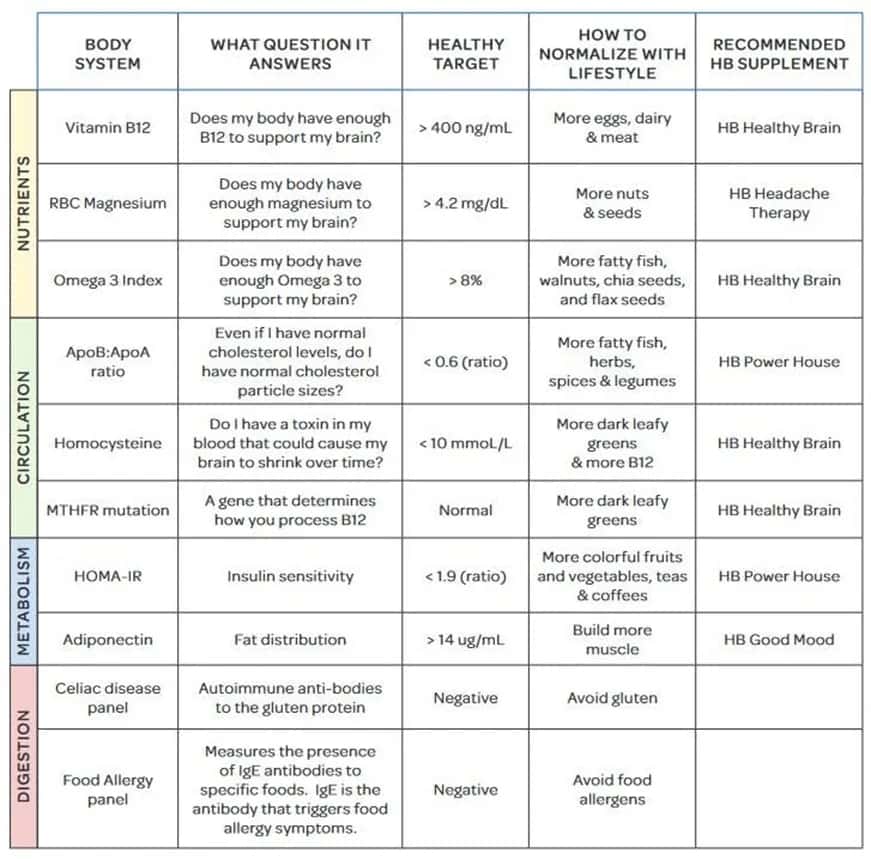
How does your body health relate to your brain health?
Our bodies provide the essential nutrients our brains need. When our body systems are working well, they support the creation of more neurons and stronger connections between them. People with strongly connected brains often feel happier, calmer, sharper, and more energetic.
If you want to know if your body is healthy enough for your brain, you can check 10 key biomarkers through routine blood tests. These biomarkers measure your nutrient levels along with circulatory, metabolic, and digestive health. Getting your biomarkers on target can support your mood, wit, and energy levels today while also supporting long-term brain health.
The brain is still one of the final frontiers of medicine. We are learning more every day about how to support brain function and brain health. In the meantime, one practical step is discussing the following tests with your doctor.
Biomarkers of nutrition
Vitamin B12, RBC Magnesium, and Omega 3 Index are three key biomarkers of nutrition.
1. Vitamin B12
What is the Vitamin B12 biomarker?
Vitamin B12 level is a blood test that measures your levels of cobalamin, or Vitamin B12.
Why is Vitamin B12 important?
Vitamin B12 helps the body convert food into neurotransmitters. When we get enough B12, our bodies and brains can make enough dopamine, norepinephrine, and serotonin, the neurotransmitter chemicals that help us make brain connections. Strong brain connections support energy, mood, and mental sharpness. The right amount of B12 may also help reduce age-related brain shrinkage.
Who is typically low on B12?
Around 20 percent of adults may be low on B12 by traditional guidelines, while newer neuroscientific guidance suggests the number may be closer to 40 percent. Vegans and people taking reflux medications such as antacids or proton pump inhibitors may be at higher risk.
What is a brain-healthy B12 level?
A level of at least 400 ng/mL is considered important for the brain and nerves. The recommended daily allowance is 2.4 mcg per day.
Best food sources
Eggs, dairy, and meat are some of the best dietary sources of B12.
Supplement note
Regular B12 and methylated B12 are both available. People with MTHFR variation may benefit more from methylated B12. Honeybrains notes that HB Healthy Brain contains methylated B12 along with other essential brain nutrients.
2. Red Blood Cell Magnesium
What is RBC Magnesium?
RBC Magnesium is a blood test that measures how much magnesium is inside your cells. When the body has enough magnesium, many organ systems, including the brain, benefit.
Why does it matter?
Magnesium is required for nearly every metabolic process in the body and brain. Many people do not get enough magnesium from food today, partly because soil nutrient levels are lower than they once were.
Who is typically low?
Roughly half of the U.S. population consumes less than the recommended amount of magnesium. People with frequent headaches or stomach discomfort may be especially affected.
Brain-healthy target
A brain-healthy RBC Magnesium target is at least 4.3 mg/dL. Around 400 mg per day is often needed to maintain a healthy level.
Best food sources and supplements
Nuts and seeds are strong food sources. Supplements may come in the form of magnesium oxide, citrate, or glycinate. Honeybrains notes that HB Healthy Brain and HB Headache Therapy can also help support magnesium intake.
3. Omega 3 Index
What is the Omega 3 Index?
This biomarker measures how much DHA and EPA Omega 3 fats are present in red blood cell membranes. Higher levels are linked with healthier brains over time.
Who is typically low?
Most adults in the U.S., especially women and children, consume less than half of the daily Omega 3 target.
Brain-healthy target
The target Omega 3 Index is greater than 8 percent. A general daily intake target is around 250 to 500 mg of EPA and or DHA.
Best food sources and supplements
Fatty fish such as salmon, sardines, mackerel, anchovies, and herring are top sources. Walnuts, chia seeds, and flax seeds are useful plant-based sources. Honeybrains also highlights fish oil powder in HB Healthy Brain for those looking for a supplement.
Biomarkers of circulatory health
ApoB:ApoA, Homocysteine, and MTHFR are key biomarkers of circulatory health. Healthy circulation supports healthy brain aging.
4. ApoB:ApoA Ratio
What is it?
This biomarker measures the balance of inflammatory versus non-inflammatory cholesterol particles in the blood. It provides more information than a routine cholesterol test.
Who may have suboptimal levels?
People with a family history of heart disease, cholesterol problems, or diabetes may be at higher risk. Diet, lifestyle, and metabolic health also play a major role.
Brain-healthy target
A target ApoB:ApoA ratio is less than 0.6.
Ways to improve it
More fatty fish, herbs, spices, and fiber-rich foods like peas and beans can help support a healthier ratio. Honeybrains notes that HB Power House may also support metabolic health tied to this marker.
5. Homocysteine
What is it?
Homocysteine is an amino acid measured in the blood. Higher than normal levels can harm circulation and increase risk for brain shrinkage, stroke, and Alzheimer's disease.
Who may have high levels?
People with B12 deficiency, migraines, chronic fatigue, chronic pain, inflammatory conditions, tobacco use, or MTHFR variation may be at greater risk.
Brain-healthy target
A level of 10 mmol/L or below is considered supportive of healthy brain aging.
Ways to support healthier levels
Folate-rich plant foods like spinach, asparagus, Brussels sprouts, and broccoli can help. Honeybrains also points to HB Healthy Brain for added B12 and folate support.
6. MTHFR
MTHFR is a gene involved in converting homocysteine into neurotransmitters using B12 and folate. Some people have mutations that make this process less efficient. In those cases, methylated B12 may be more effective than regular B12. Honeybrains notes that HB Healthy Brain contains methylated B12 and can support people with or without MTHFR variation.
Biomarkers of metabolic health
HOMA-IR and Adiponectin measure metabolic health. The better our metabolism, the better our brains can function across life.
7. HOMA-IR
What is it?
HOMA-IR helps measure how much insulin the body is making in response to sugar intake. It reflects insulin sensitivity and metabolic efficiency.
Who may have a slow metabolism?
About 34 percent of U.S. adults have some degree of metabolic inefficiency. Family history, lifestyle, and body composition can all influence this.
Brain-healthy target
A brain-healthy HOMA-IR level is less than 1.9.
Ways to improve it
Colorful fruits and vegetables, teas, coffees, and spices like cinnamon, saffron, and turmeric may help. Building muscle also supports better metabolism. Honeybrains points to HB Power House and HB Healthy Brain for extra support through food-based ingredients and plant pigments.
8. Adiponectin
What is it?
Adiponectin is a hormone made by fat cells. Healthy levels tend to be associated with more muscle and less fat around the organs, which supports better metabolic and circulatory health.
Who may have abnormal levels?
People with low muscle mass or higher body fat may be more likely to have lower adiponectin.
Brain-healthy target
A target adiponectin level is at least 14 ug/mL.
Ways to improve it
Building more muscle can improve adiponectin. Honeybrains also notes that HB Power House and HB Good Mood contain ingredients tied to metabolic support.
Biomarkers of digestive health
Celiac disease and food allergy testing can provide insight into digestive health, especially for people dealing with frequent stomach discomfort.
9. Celiac Disease
What is it?
Celiac disease is an autoimmune disorder in which the immune system reacts to gluten, a protein found in grains like wheat, barley, rye, and spelt. Over time, this reaction can damage the lining of the digestive system and interfere with nutrient absorption.
How can it be tested?
It can be checked through a blood test that measures anti-gliadin and tissue transglutaminase antibodies.
If levels are abnormal
Avoiding gluten-containing foods is often the best next step, while still including appropriate non-gluten whole grains such as amaranth, buckwheat, brown rice, wild rice, polenta, and oats.
10. Food Allergies
What are they?
Food allergies happen when the immune system reacts to a specific food allergen, causing inflammation and digestive discomfort that may interfere with nutrient absorption.
Common food allergens
Common triggers include cow's milk, eggs, tree nuts, peanuts, shellfish, wheat, soy, and fish.
How can they be tested?
Food allergies can be checked through skin tests and or blood tests that measure IgE antibodies to specific foods.
What if it is not celiac disease or a food allergy?
If those tests are negative and belly discomfort continues, especially during stress, it may be worth asking your doctor about irritable bowel syndrome, or IBS. Symptoms can include bloating, cramping, gas, diarrhea, constipation, or reflux-like discomfort. Honeybrains notes that magnesium may help support symptoms for some people and points to HB Healthy Brain and HB Headache Therapy as options that contain magnesium.
Download the full guide
Want to save this for later or share it with your doctor. Download the full PDF below.
Download This Blog Here